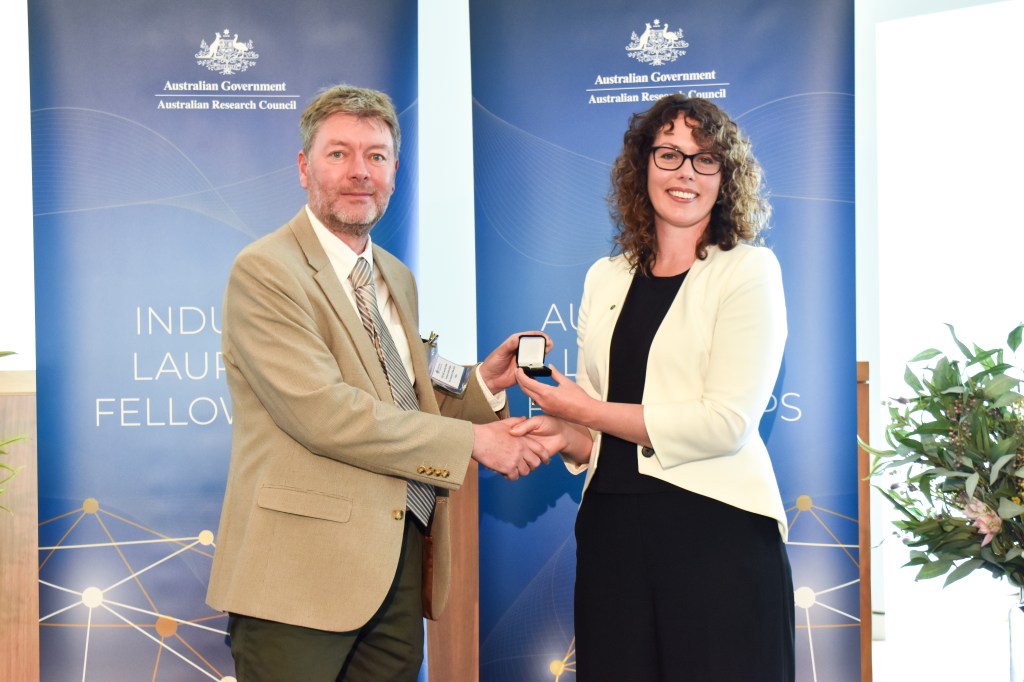
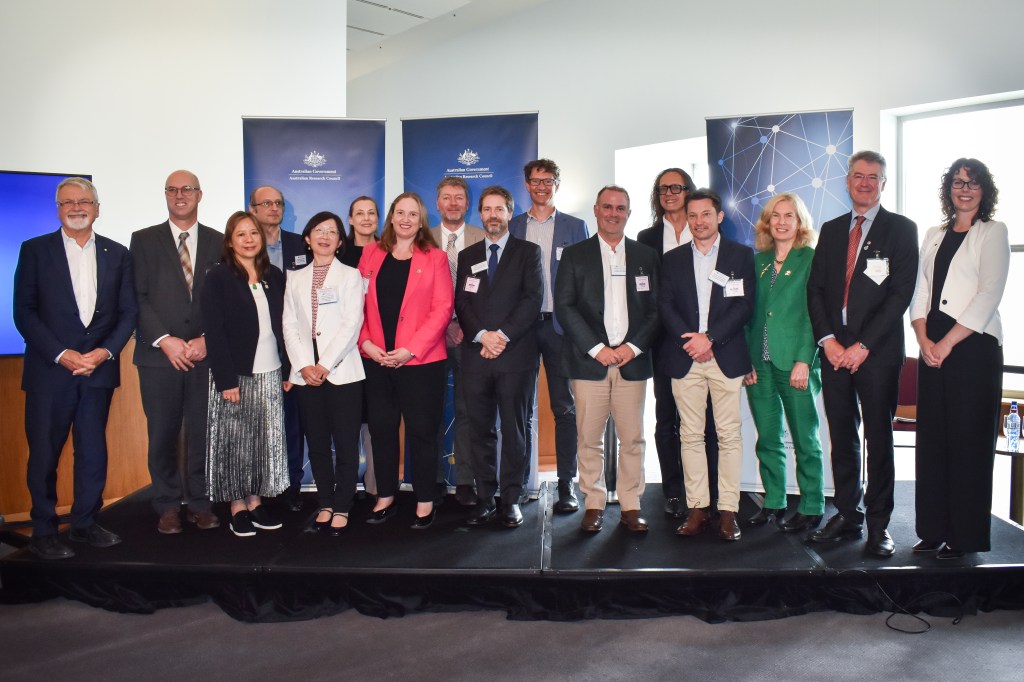
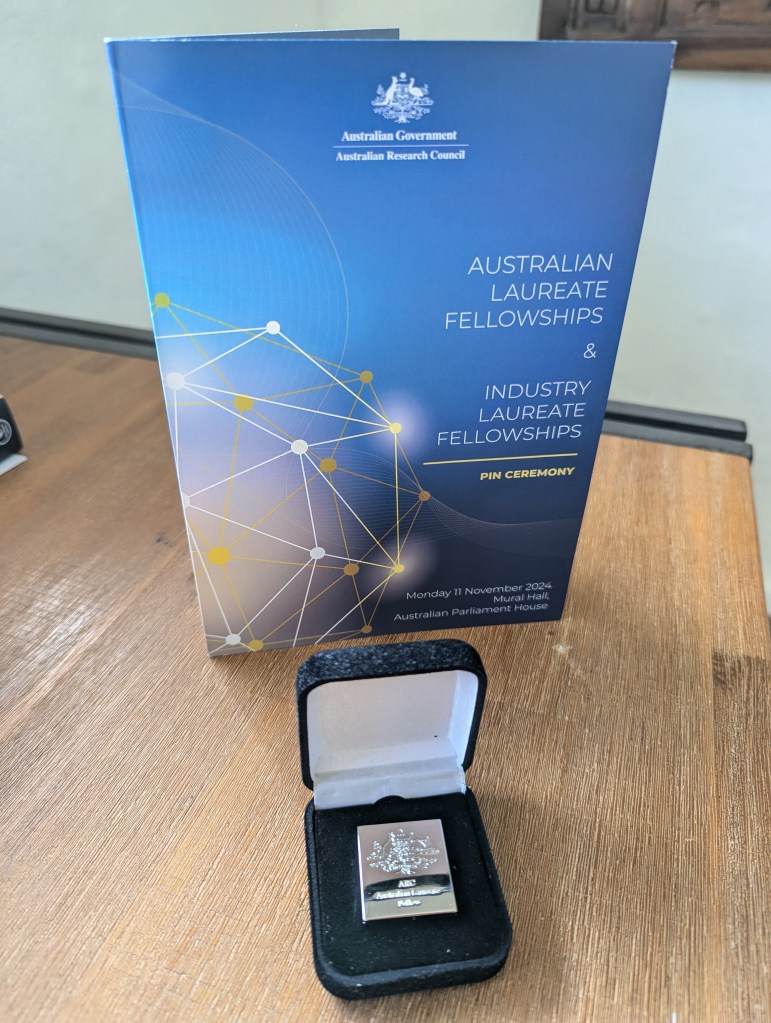
Last week I had the honour of attending the ARC’s annual Laureate Pin Ceremony, celebrating Australian Laureate Fellowship recipients and Industry Laureate Fellowship recipients. It was wonderful to celebrate with family and meet old and new colleagues. I received my pin in Australia’s Parliament House in Canberra from the Federal Member for Canberra, Ms Alicia Payne MP.
Over the next five years, I will be building a network of collaborators and training early career researchers to tackle the question of groundwater recharge – that is, the replenishment of groundwater. The research will use cave stalagmites to obtain records of the timing of groundwater recharge in the recent past. It will use modern day hydrological measurements in caves, tunnels and mines to quantify how much rainfall is needed for groundwater recharge to occur, collaborating with my colleagues leading the National Groundwater Recharge Observing System. And it will use climate and groundwater recharge models to relate groundwater recharge to climate drivers such as the El Niño and Indian Ocean Dipole. We are currently recuiting two postdoctoral researchers to join the team to work on climate modelling and stagmite records of past recharge.
Why is it important to understand when our groundwater resource is replenished? Groundwater is the largest freshwater resource on Earth, it makes up around 17% of all accessible water in Australia and accounts for more than 30% of total water consumption. Australia is the driest inhabited continent on Earth, with few surface water resources relative to other continents, and therefore the reliance on groundwater is even more critical.
Critically, the link between climate and groundwater recharge remains unknown because existing records of groundwater recharge are not long enough and not of high enough resolution to enable comparison with the climate drivers such as the El Niño – Southern Oscillation (ENSO) and Indian Ocean Dipole (IOD). Our current lack of understanding of how climatic processes modulate the timing and frequency of recharge leaves our groundwater resources vulnerable to over abstraction and climate change.
The research has global relevance, as caves are typically found in all karstified carbonate lithologies. Our approach will inform the sustainable management of these groundwater reources, not just in Australia, but also worldwide. Over one billion people, 16.5% of the global population, live on and interact with this lithology, the greatest number in Asia (661.7 million people) and the highest percentages in Europe (25.3% of Europeans) and North America (23.5% of the population).
Interested to read more? The project builds on long-term collaboration with Dr Pauline Treble (ANSTO) on the use of cave stalagmites as records of past recharge (Cosmos Magazine) and the use caves as observatories of groundwater recharge (Royal Society NSW lecture) with the backstory covered by Cosmos Magazine here.
 Andy Baker
Leave a comment