AMOS – the Australian Meteorological and Oceanographic Society – meet annually. This year was the 31st AMOS conference, and my 1st.
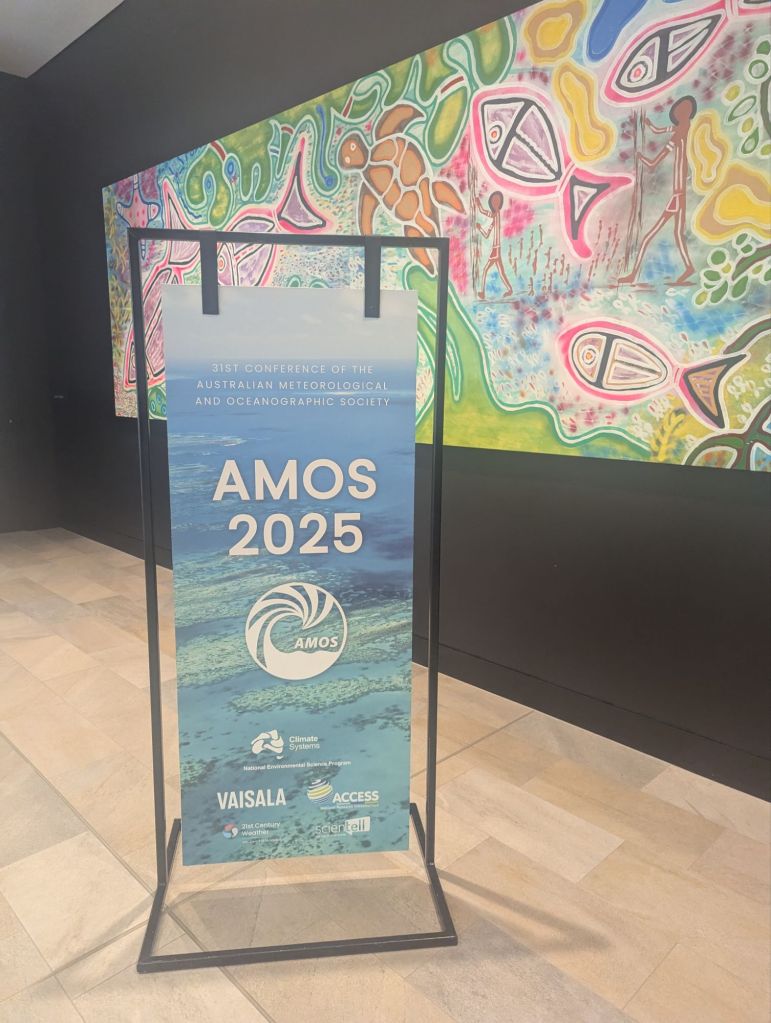
This week, I have been learning about compound weather events, extreme rainfall, and how climate drivers such as La Nina influence Australian rainfall.
Why am I interested? We (Stacey Priestley, Margaret Shanafield, Wendy Timms, Martin Andersen, Marilu Melo Zurita and I) – https://agupubs.onlinelibrary.wiley.com/doi/full/10.1029/2024GL113503 (Open Access) – recently published data that shows that you need very high rainfall amounts for water to reach the groundwater. From subtropical Queensland through to hot temperate South Australia, and every site in between, we find the same result for every geology and rock type. We need rain events that are in the top 10% of all rainfall for that site. Or in simpler terms, drizzle is not enough, a weather front is not enough, and almost all convective (“thunder”) storms do not produce enough rain for groundwater to be replenished. More severe events are needed, for example, ‘East Coast Lows’ in the east of the country.
Thanks to the organisers, I was able to present this research to the meteorology and climate community at the conference. Our intention is to be able to link our observed recharge events to climate patterns and climate drivers such as ENSO, and understand how groundwater recharge will change with climate change.

For more coverage of the presentation, Melissa Lyne, has this post on LinkedIn
AMOS2026 will be held in Tasmania in February. I plan to be there. Thanks to the Cairns Convention Centre for hosting this year

 Andy Baker
Leave a comment