Every few years the International Atomic Energy Association co-ordinate a global inter-lab comparison of water isotope labs. This year it was time for WICO 2024 – the latest IAEA Water Stable Isotope Intercomparison.
This huge effort from the IAEA team involves sending ‘unknown’ water samples to participating labs around the world. The labs then send in their results, and the IAEA assesses each labs performance. This is an amazing service to the scientific community and one that is vitally important. The measurement of the isotopic composition of water, that is the isotopes of hydrogen and oxygen, can tell us about a wide range of environmental processes.
Here in the School of Biological, Earth and Environmental Sciences at UNSW we have a water isotope analytical facility. The instrument, and off-axis laser spectroscopy system produced by Los Gatos Research (now ABB) is now getting relatively old. It has around 10 years of loyal service, mostly analysing melted ice core samples to understand past climates, and groundwater samples to understand groundwater sources. It has been used for undergraduate teaching, especially for our second year Earth Science students, including during the pandemic and on-line classes, as shown in the picture below. Inside, the instrument has been cannabilised for parts, with valves formerly meant for vapour analyses now used for water isotope samples. The optics have been cleaned a few times. The hard drive has failed more than once. The autosampler is even older.
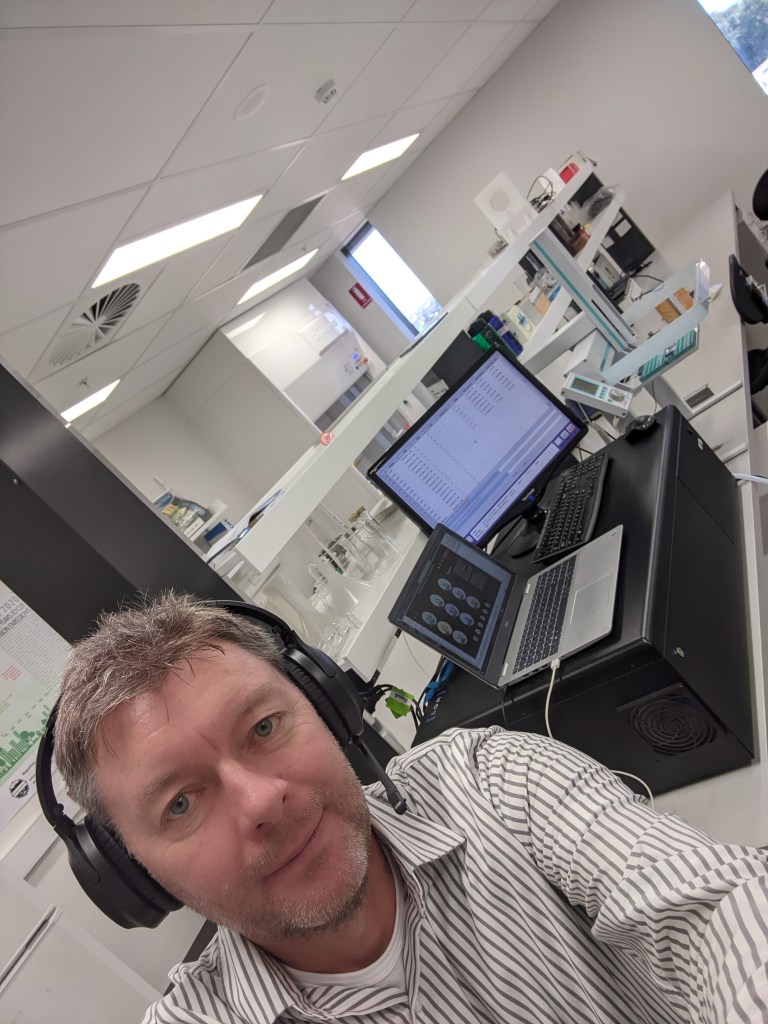
But still, it passes WICO 2024 with flying colours. So this is a thank you! To my colleagues at ANSTO for providing secondary standards that were used in our analyses. To the IAEA for running WICO 2024. And to my colleagues who found space to run some WICO 2024 samples in their sample runs.
 Andy Baker
Leave a comment